Physics 2019
Objective Questions
The time rate of increase in velocity is called
Correct Answer: D. acceleration
Which of the following quantities is a vector?
Correct Answer: C. Momentum
In an elastic collision, momentum is conserved as well as
Correct Answer: C. kinetic energy
The induced current in a coil always flows in a direction so as to oppose the change causing it. This statement is known as
Correct Answer: C. Lenz's law
Which of the following instruments can be used to compare the magnitudes of charges on two given bodies?
Correct Answer: B. Gold-leaf electroscope
A body of mass 2kg is released from a point 100 m above the ground level. Calculate its kinetic energy 80 m from the point of release. [g = 10 m s-2]
Correct Answer: B. 1600 J
Which of the following waves is not mechanical?
Correct Answer: D. Radio waves
A loaded spring is set in simple harmonic motion. The force that tends to restore the load to its equilibrium position is
Correct Answer: D. adhesive
Which of the following situations cannot produce total internal reflection? A light ray travelling from
Correct Answer: A. water to kerosene
The vacuum in a thermos flask reduces heat loss resulting from
Correct Answer: B. conduction and convection only
The diagram above represents an experimental set-up for verifying
Correct Answer: D. laws of reflection
Which of the following statements about a moving object is correct?
Correct Answer: D. At a steady speed, the resultant force acting on it must be equal to zero
The efficiency of a transformer is 100 %. Which of the following equations would be correct?
Correct Answer: C. NsIp = NpIs
A freshly demagnetized bar magnet is placid In East-West direction to ensure that,
Correct Answer: D. magnetic domains are orderly aligned
Which of the following graphs correctly represents the plot of the charge Q against the potential difference V in a capacitor?
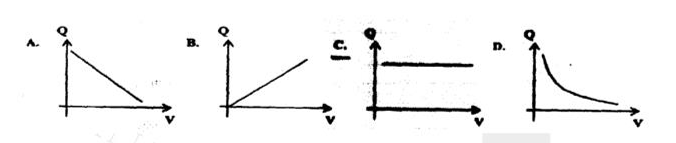
Correct Answer: B. Graph B
A small amount of air is introduced into the vacuum above the mercury in a mercury barometer tube. The mercury level fails because the air molecules
Correct Answer: C. increase the pressure above the mercury
Calculate the quantity of heat needed to change 60 g of ice at 0.0 °C to water at 80.0 °C. [Specific latent heat of fusion of ice = 3.36 x 10⁵ J kg-1, specific heat capacity of water = 4.2 x 10³ J kg-1 K-1]
Correct Answer: B. 40.32 kJ
The wire of a platinum resistance thermometer has a resistance of 3.5 Ω at 0 °C and 10.5 Ω at 100 °C. Calculate the temperature of the wire when its resistance is 7.5 Ω.
Correct Answer: A. 57°C
A transverse wave of frequency 9 Hz travels 4.5 m in 0.6 s. Calculate the wavelength of the wave.
Correct Answer: D. 0.83m
The speed of sound is least in which of the following media?
Correct Answer: B. Air
Which of the following characteristics of waves can be demonstrated using a ripple tank? I. Reflection II. Refraction III. Diffraction
Correct Answer: D. I, II and III
Which of the following graphs gives the correct relationship between energy and mass when mass is converted to energy?
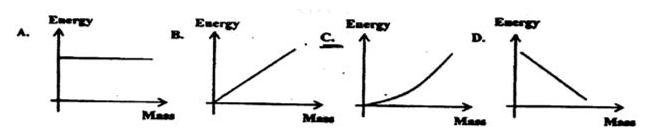
Correct Answer: B. Graph B
An 800 kg car moving at 80 km h-1 collides with a 1200 kg car moving at 40 km h-1 in the same direction. If the cars stick together, calculate their common speed.
Correct Answer: A. 56 km h-1
The mass of an object is doubled while the force acting on it is halved. The resulting acceleration of the object is
Correct Answer: C. quartered
the maximum and minimum thermometer reads the
Correct Answer: C. maximum temperature during the day and minimum temperature at night at all times
An a.c. generator can be converted to a d.c. generator by replacing the
Correct Answer: B. slip rings with a commutator
Which of the following statements is the correct reason for which soft iron is used in making the armature of an electric bell? Soft iron
Correct Answer: C. loses its magnetism easily
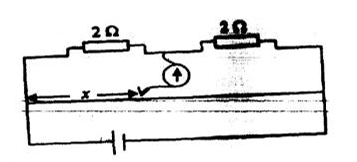
The diagram above illustrates a metre bridge circuit under balanced condition.
Determine the value of x.
Correct Answer: D. 28.6cm
Which of the following devices is used for storing electric charge?
Correct Answer: A. Capacitor
An electron of mass 9.1 x 10⁻³¹ kg moves with a speed of 2.0 x 10⁶ m s-1 round the nucleus of an atom in a circular path of radius 6.1 x 10⁻¹¹ m. Use this information to answer questions 30 and 31.
Determine the angular speed of the electron.
Correct Answer: B. 3.28 x 10¹⁶ rad s-1
Calculate the centripetal force acting on the electron.
Correct Answer: C. 6.0 x 10⁻⁸ N
A device consumes 100 W of power when connected to a 120 V source. Calculate its resistance.
Correct Answer: A. 144 Ω
Which property of a wave remains constant When the wave travels cm one medium into another?
Correct Answer: A. Frequency
The anomalous expansion of water occurs in the range
Correct Answer: B. 0 oC to 4 oC
A ray of light travelling from a rectangular glass block of refractive index 1.5 into air, strikes the block air boundary at an incident angle of 30o. Calculate the angle of refraction.
Correct Answer: D. 19.5°
A rectangular piece of iron measuring 4 cm x 3 cm at 20°C is heated until its temperature increases by 100°C. Calculate the new area of the meatal of the metal. [Linear expansivity of iron = 1.2 x 10⁻⁵ K-1]
Correct Answer: A. 12.0173 cm2
Two bodies of masses 3.0 kg and 2.0 kg are 50 cm apart. Calculate the force of attraction between them. [G= 6.67 x 10⁻¹¹ N m2 kg-2]
Correct Answer: B. 1.6 x 10⁻⁹ N
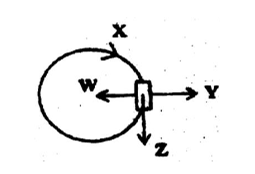
The diagram above illustrates an object moving in a circular path at constant speed. Which of the arrows correctly indicate the direction of linear velocity?
Correct Answer: B. Z
Which of the following thermometers is used to measure the temperature of the human body?
Correct Answer: C. Alcohol-in-glass thermometer
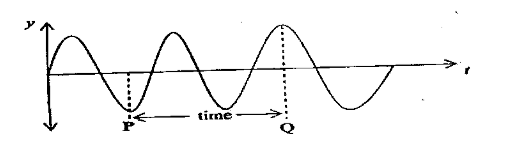
In the diagram above, the time taken to trace a wave between P and Q is
Correct Answer: A. 1 ½ periods
Which of the following components does not serve as a safety device in electrical circuits?
Correct Answer: B. Connecting wires
Which of the following liquids has the highest surface tension?
Correct Answer: C. Cold water
The nucleon and proton numbers of a neutral atom of an element are 238 and 92 respectively. Determine the number of neutrons in the atom.
Correct Answer: A. 146
An instrument used to measure relative humidity is the
Correct Answer: B. hygrometer
The area under a velocity-time graph represents
Correct Answer: A. distance
Which of the following statements about neutral atom is correct? The
Correct Answer: A. number of protons is equal to that of electrons
The property that is not exhibited by sound waves is
Correct Answer: C. polarization
When ultraviolet light is incident on the surface of certain metals, particles are emitted. These particles are called
Correct Answer: A. photoelectrons
Niels Bohr drew certain conclusions about the structure of the atom. Which of the following statements is one of those conclusions?
Correct Answer: C. Within an atom, there are certain allowed orbits
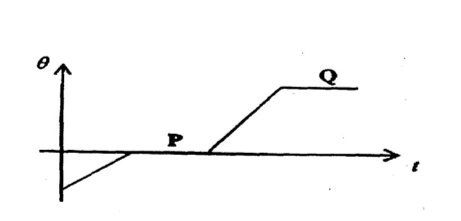
The graph above illustrates the variation of temperature with time for a solid that is being heated. Which processes take place at the segments P and Q respectively?
Correct Answer: D. Melting and boiling
Theory Questions
A stone of mass 20g is released from a catapult whose rubber is stretched through 5cm. If the force constant of the rubber is 200Nm-1, calculate the speed with which the stone leaves the catapult.
The diagram below illustrates a projectile motion.
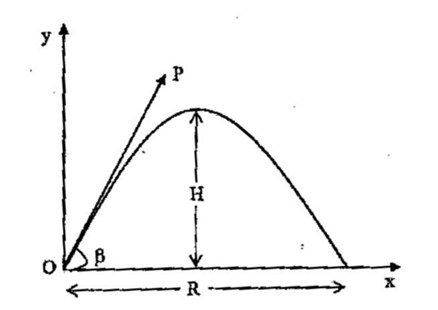
- Identify each of the physical quantities labelled P, β, H and R.
- Write an equation to show the relationship between P, g and Rmax, where g is the acceleration due to gravity and Rmax is maximum R.
State three observable phenomena in which waves behave like a particle.
List three magnetic elements that determine the earth’s magnetic field at a point.
Explain this term as used in Electronics:
- Free electrons
- Holes
- State the principle of operation of fibre optics
- State two applications of fibre optics in medicine
- Define diffusion
- State two factors that affect the rate of diffusion
- State Newton’s Law of Universal Gravitation
- Define gravitational field
- Derive the equation relating the universal gravitational constant, G, and the acceleration of free fall, g, at the surface of the earth from Newton’s law of universal gravitation
- State two assumptions for which the relationship in 8(b)(i) holds
- Calculate the force of attraction between a star of mass
2.00 × 1030 kg and the earth assuming the star is
located 1.50 × 1080km from the earth.
[Mass of the earth = 5.98 × 1024kg, G = 6.67 × 10⁻¹¹Nm2kg-2, g = 10ms-2] - Define escape velocity
- State two differences between the acceleration of free fall (g) and the universal gravitational constant (G).
- Explain latent heat
- State two factors that affect the rate of evaporation of a liquid
- Explain this observation:
On a dry day, water in a clay pot is cooler than water in a closed plastic container. - Explain this observation:
Food gets cooked faster in a pressure cooker than in an ordinary cooking pot. - State two effects of heat on a substance
- A 40V electric heater is used to supply a current of 12A for 1400s to a body of mass 1.5kg at the melting point of the body. The body melts and its temperature rises through 60°C in an extra 72s.
- Determine the latent heat of fusion of the body.
- Determine the specific heat capacity of the body.
- Define atomic spectra
- Differentiate between emission spectra and absorption spectra
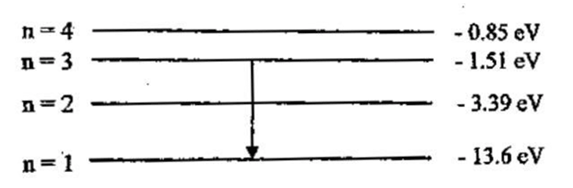
- The diagram above illustrates an electron transition from energy level n = 3 to n = 1.
- Calculate the energy of the photon
- Calculate the frequency of the photon
- Calculate the wavelength of the photon
- Differentiate between soft x-rays and hard x-rays
- Draw the circuit symbol for a p – n junction diode
- Give the reason for doping a semiconductor material
- Define force and state its S. I. unit
- List the two types of solid friction
- A car travelling at a constant speed of 30 ms-1 for 20s was suddenly decelerated when the driver sighted a pot-hole. It took the driver 6s to get to the pot-hole with a reduced speed of 18ms-1. He maintained the steady speed for another 10s to cross the pot-hole. The brakes were then applied and the car came to rest 5s later.
- Draw the velocity-time graph for the journey
- Calculate the deceleration during the last 5s of the journey
- Calculate the total distance covered
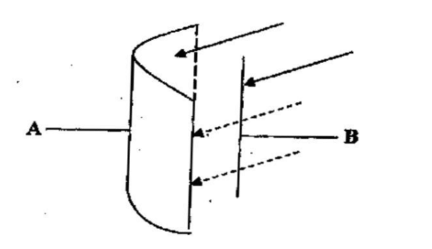
- The diagram above illustrates a structure of a typical photocell. Identify each of the parts labelled A and B.
- State one function for each of A and B
- Einstein’s photoelectric equation can be written as E = hf – Wo. State what each of the terms E, hf, and Wo represents.
- A photon is incident on a metal whose work function is
1.32eV. An electron is emitted from the surface
with a maximum kinetic energy of 1.97 eV. Calculate the
frequency of the photon.
[1ev = 1.6 x 10⁻¹⁹] - Define half-life of a radioactive element
- Sketch a graph of the relation N = N0e–λt Sketch a graph of the relation N = N0e–λt
Practical Questions
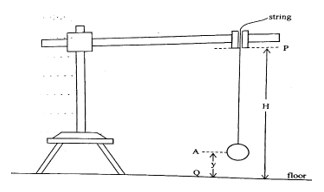
- You are provided with a stopwatch, a meter rule, a split
cork, retort stand and
clamp, a pendulum bob, a piece of thread and other necessary
apparatus.
- Place the retort stand on a laboratory stool. Clamp the split cork.
- Suspend the pendulum bob from the split cork such that the point of support P of the bob is at a height H = 100 cm above the floor Q. The bob should not touch the floor and H should be kept constant throughout the experiment.
- Adjust the length of the thread such that the centre A of the bob is at a height y = AQ = 20 cm from the floor.
- Displace the bob such that it oscillates in a horizontal plane.
- Take the time t for 20 complete oscillations.
- Determine the period T of oscillation and evaluate T2.
- Repeat the procedure for four other values of y =30 cm, 40 cm, 50 cm and 60 cm. In each case, determine T and T2.
- Tabulate the results.
- Plot a graph of T2 n the vertical axis and y on the horizontal axis, starting both axes from the origin (0, 0).
- Determine the slope, s, of the graph and the intercept c on the vertical axis.
- If in this experiment, SR = c, calculate R.
- State two precautions taken to ensure accurate results.
-
- The bob of a simple pendulum is displaced a small
distance from the
equilibrium position and then released to perform
simple harmonic motion.
Identify where its:- kinetic energy is maximum;
- acceleration is maximum.
- An object of weight 120 N vibrates with a period of
4.0 s when hung from a
spring. Calculate the force per unit length of the
spring.
[g = 10 ms-2, π = 3.142]
- The bob of a simple pendulum is displaced a small
distance from the
equilibrium position and then released to perform
simple harmonic motion.
- You are provided with a converging lens and holder; a
screen, a ray box containing
an illuminated object pin and a meter rule.
- Place the lens in its holder such that it is facing a distant object seen through a well-lit laboratory window. Move the screen to and fro until a sharp image of the distant object is formed on it. Measure the distance, fo , between the screen and the lens.
- Clamp the meter rule securely to the table.
- Place the illuminated object pin at the end R of the meter rule. Place the lens at a position P such that X = RP = 20 cm.
- Move the screen to a position Q to receive a sharp image of the object. Measure the distance Y = PQ.
- Evaluate Z = (X + Y).
- Repeat the procedure for five other values of x = 25 cm, 30 cm, 40 cm and 45 cm. In each case, record X, Y and evaluate Z.
- Tabulate the results.
- Plot a graph with Z on the vertical axis and X on the horizontal axis. Draw a smooth curve through the points.
- Determine from your graph the minimum value of Z = Zo and its corresponding distance Xo.
- Evaluate W = ½(Zo/4+Xo/2)
- State two precautions taken to ensure accurate results.
-
- Draw a ray diagram to show how a convex lens forms an image of magnification less than one.
- Name two pairs of features in the human eye and a lens camera that performs similar functions.
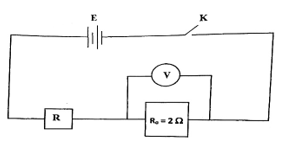
- You are provided with a battery of e.m.f. E, a key K, a
voltmeter, a standard
resistor Ro = 2, a resistance box R and some connecting
wires.
- Measure and record the e.m.f. E of the battery.
- Set up a circuit as shown in the diagram above with the key open.
- Set the resistance on the resistance box to R = 2.
- Close the key, read and record the potential difference V on the voltmeter.
- Evaluate V-1.
- Repeat the procedures for five other values of R = 5 Ω, 10 Ω, 12 Ω, 15 Ω and 20 Ω. In each case, record V and evaluate V-1.
- Tabulate the results.
- Plot a graph with R on the vertical axis and V-1 on the horizontal axis, starting both axes from the origin (0, 0)
- Determine the slope, s, of the graph and the intercept c on the vertical axis.
- Calculate α and β from the equations s = Ro α and c = - (Ro + B).
- State two precautions taken to ensure accurate results.
-
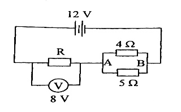
- In the circuit diagram above, the battery has negligible internal resistance. Calculate the power dissipated as heat in the section AB of the circuit.
- An electric equipment of power rating 3.6 kW is to be connected to a 240 V line whose circuit breaker is rated 20 A. Justify whether or not the breaker would open when the equipment is switched on. [4 marks]